
Sanatani streetwear — sometimes called spiritual streetwear — is what happens when ancient symbols step off the temple wall and onto an oversized tee. Om, Sanskrit shlokas, sacred geometry, deities — worn not as costume, but as everyday armour. It’s the fastest-growing corner of Indian streetwear, and it’s not a coincidence.
Table of Contents
What Sanatani streetwear actually means
Most streetwear runs on logos and hype. You wear the brand; the brand says nothing about you.
Sanatani streetwear flips that. The graphic isn’t a logo — it’s a symbol that already carries meaning, thousands of years of it. A Trishul, a mantra, the geometry of a Sri Yantra. You’re not renting someone’s clout. You’re carrying something that means something to you.
That’s the whole appeal for young India right now: heritage worn loud, on your own terms. Not your grandparents’ devotion, not a costume — a fit that happens to be rooted in something real.
The design language
Sanatani streetwear pulls from a deep, recognisable visual vocabulary. A few of the motifs you’ll see most:
| Symbol | What it carries | The energy it gives a fit |
|---|---|---|
| Om (ॐ) | The primordial sound, the source of everything | Grounded, calm, centred |
| Trishul | Shiva’s trident — cutting through ego | Bold, warrior, unbothered |
| Lotus | Rising clean out of muddy water | Growth, resilience |
| Sri Yantra | Sacred geometry, cosmic order | Meditative, hypnotic |
| Nataraja | The cosmic dance of creation and destruction | Dynamic, in motion |
| Sanskrit shlokas | Intention, spoken and worn | Mindful, quietly powerful |
The strongest designs don’t just slap a symbol on cotton. They treat it like the artwork it is — spacing, line weight, and negative space all working so the piece breathes.
Rooted, not random
Here’s the line between Sanatani streetwear that lands and the stuff that feels hollow: knowing what you’re wearing.
A well-made Om tee worn by someone who gets the meaning reads completely differently from a random symbol grabbed off a template because it “looked cool.” Same graphic, opposite energy. The intention shows.
That respect runs into the product too. Sacred art deserves a garment that honours it — clean printing, heavyweight cloth, a cut that gives the design room. Cheap fabric and a blurry print undercut the whole idea. If you’re going to carry a symbol that’s outlived empires, the tee should at least survive a few washes.
Why it works on oversized heavyweight cotton
Intricate art needs a canvas. That’s why Sanatani streetwear and the oversized cut go hand in hand — the boxy, roomy shape gives detailed geometry and Sanskrit the space to actually read, instead of getting swallowed by folds and seams.
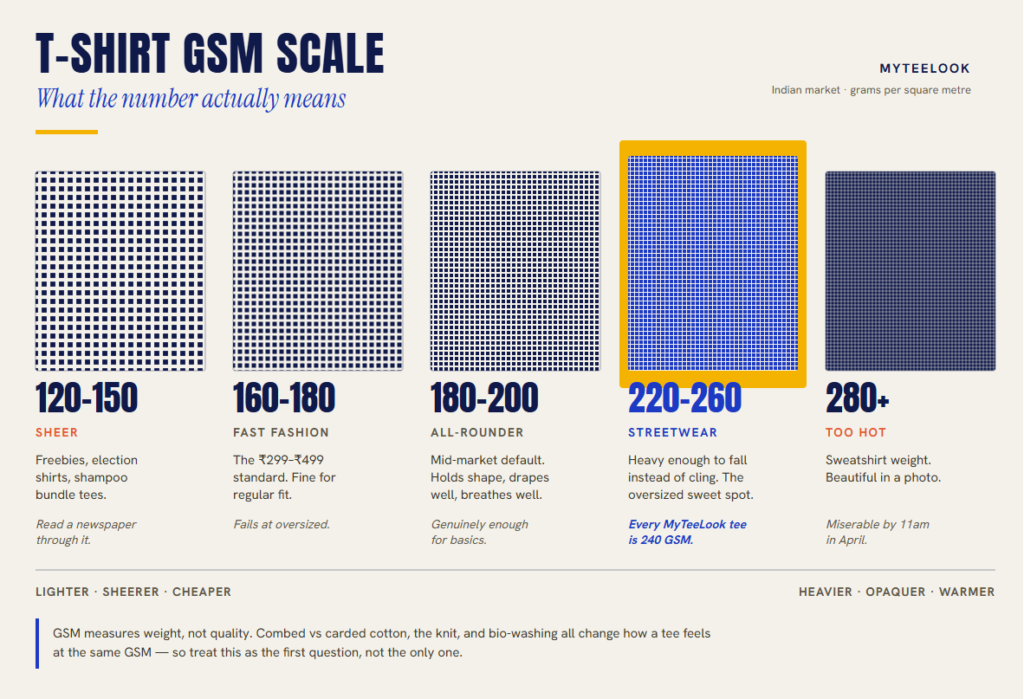
Weight matters just as much. A heavy 220–240 GSM fabric holds fine linework crisp and hangs with a structure that flimsy cotton can’t. Pair that with combed cotton for a smooth, premium surface, and detailed art sits clean and sharp.
For the print itself, dense multi-colour deity artwork and fine mantra text come out best with the right method — DTG or DTF both handle detail and gradients that screen printing struggles with.
How to style Sanatani streetwear
One rule holds it together: let the symbol be the hero. The tee is doing the talking, so keep everything else quiet.
- Bottoms: black or olive cargos, straight or wide-leg jeans. Neutral, so the graphic pops.
- Accessories: minimal. A rudraksha strand or plain silver reads intentional. A pile of chains fights the tee.
- Footwear: clean white sneakers for street, or kolhapuris for a desi-fusion lean.
- Layering: open an overshirt or shacket over it on cooler days — frame the graphic, don’t hide it.
Skip the loud logo caps and busy prints on the bottom half. Sanatani streetwear works because it says one strong thing clearly.
Caring for the print
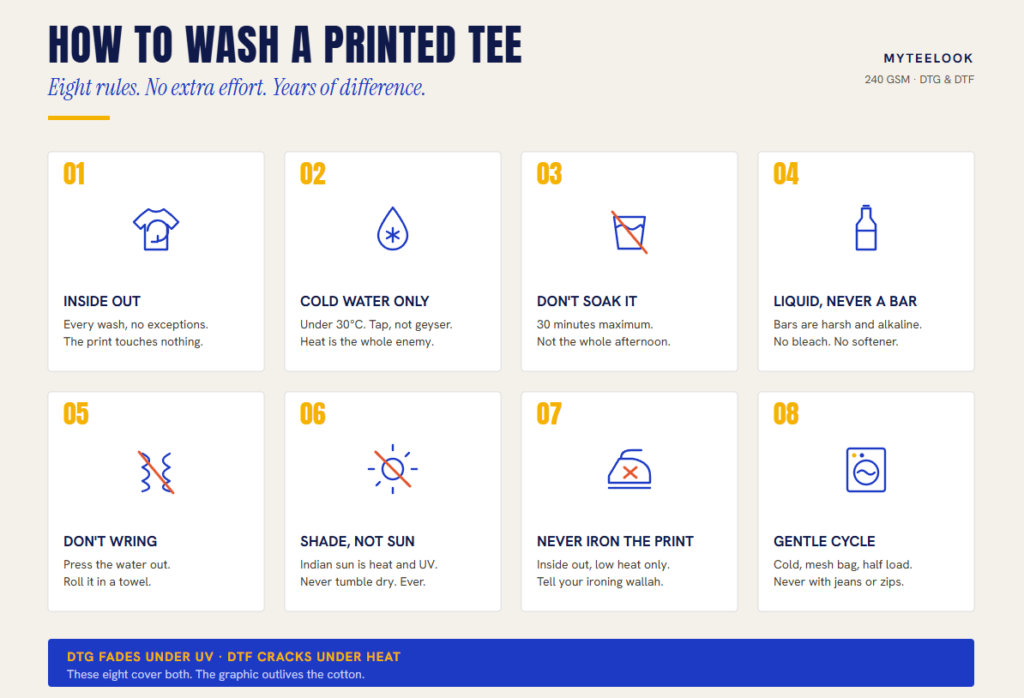
Art this good deserves to last. Wash cold, turn the tee inside out, skip harsh detergent, and air dry in shade — heat is what fades prints and shrinks cotton. The full routine is in our printed-tee wash guide. Treat it right and the design stays as sharp as day one.
FAQ
Is it disrespectful to wear religious symbols on clothing? It comes down to intention and care. Worn with awareness and respect — and printed on quality cloth, not thrown on cheap fast fashion — it reads as celebration of heritage, not mockery. Views differ, so wear what you understand and connect with.
How is Sanatani streetwear different from a normal graphic tee? A normal graphic tee is decoration. Sanatani streetwear carries symbols with real, pre-existing meaning — the graphic says something whether or not there’s a logo attached.
Is it only Hindu symbols? No. It spans yogic, Buddhist, and universal sacred geometry too — anything that turns inner meaning into wearable art.
What fabric suits these designs best? Heavyweight combed cotton, 220–240 GSM, in an oversized cut. It holds detail, hangs well, and gives the artwork space.
What do I wear it with? Keep the rest neutral — dark bottoms, clean shoes, minimal accessories — so the tee stays the centre of the fit.
Wear what means something. Explore the [Sanatani collection] and find your symbol.