Four words get used on Indian t-shirt listings as though they’re four options on the same menu: cotton, Supima, terry, acid wash.
People discuss all four as though they’re types of cotton. They aren’t the same kind of thing, and they aren’t even on the same layer. Asking whether Supima is better than terry is like asking whether flour is better than kneading.
That confusion isn’t an accident. It’s the product.
Table of Contents
The four layers behind every types of cotton argument
Every t-shirt is four decisions stacked on top of each other:
- Fibre — what it’s made of. Cotton, polyester, a blend. This is where Supima lives.
- Yarn — how the fibre is spun. Combed or carded, ring-spun or open-end.
- Knit — how the yarn is built into fabric. Single jersey, interlock, pique — and terry.
- Finish — what’s done to the fabric afterwards. Bio-wash, pre-shrink, and acid wash.
Supima is layer one. Terry is layer three. Acid wash is layer four. They aren’t competing types of cotton — they aren’t competing anything. A shirt can be all three at once.
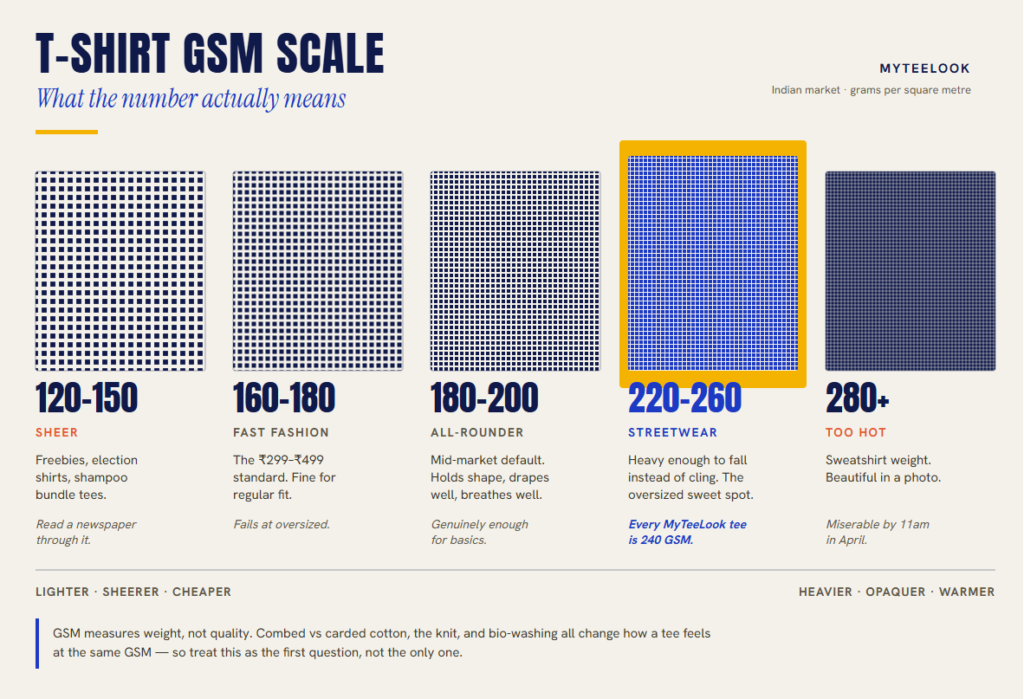
Weight — GSM — cuts across all four, which is why the fabric weight guide is a separate conversation entirely.
Types of cotton: staple length is the only thing that matters
Start here, because every claim about types of cotton is downstream of this one fact.
Cotton fibres have a length, called staple. Longer fibres mean fewer loose ends per inch of yarn, which means smoother fabric, less pilling, more strength, better dye uptake. That’s the whole science. Every claim about premium types of cotton is either describing staple length or describing nothing.
The types of cotton break down roughly like this:
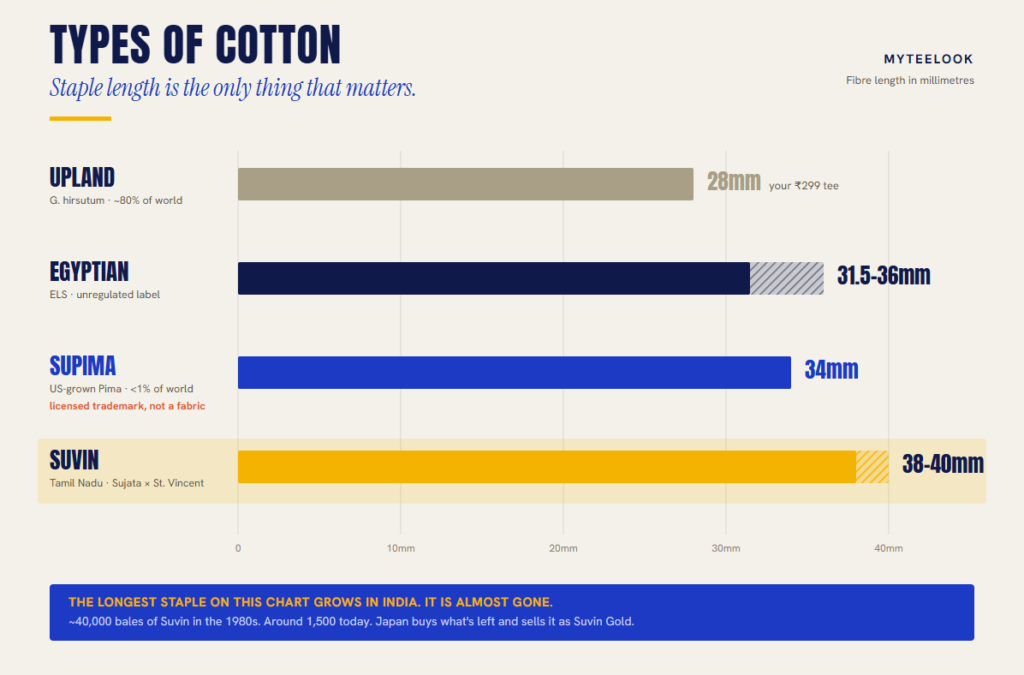
- Upland (Gossypium hirsutum) — the most common of all types of cotton, around 80% of world production. Staple about 28mm. This is what your ₹299 tee is.
- Long staple — a bit longer, noticeably better.
- Extra-long staple (ELS) (Gossypium barbadense) — 30mm and up. A different species, not just a better crop.
When a listing says “100% premium cotton” and stops there, it’s telling you the fibre is cotton. That’s it. That’s all it said.
Supima isn’t one of the types of cotton. It’s a trademark.
This is the one that annoys me.
Supima is not a type of cotton. It’s a registered trademark, owned by a US trade association founded in 1954, and the name is a contraction of “Superior Pima”. It licenses roughly 600 mills, manufacturers and brands to use the mark — and it only applies to Pima cotton grown in the United States.
Pima itself is the generic term for American-grown ELS, staple around 34mm. Good cotton — genuinely one of the better types of cotton on earth. Less than 1% of world production.
But here’s what matters for you as a buyer in India: if a brand isn’t a licensee, it cannot legally call its fabric Supima. Not “Supima”, not “Supima-like”, not “Supima-style”. The association maintains a public licensee list you can check at supima.com.
So when an Indian brand puts “Supima” on a ₹699 tee, one of two things is true. Either they’re licensed, importing American ELS cotton, and somehow selling it at ₹699. Or they aren’t.
You can guess which.
The types of cotton India actually grows — and is losing
Here’s the part nobody in Indian streetwear talks about, and it should be the whole conversation.
Suvin is an Indian ELS cotton, developed in the 1970s by crossing the indigenous Sujata variety with Sea Island cotton from St. Vincent in the Caribbean. The name is literally SU-jata plus VIN-cent. It’s grown only in Tamil Nadu.
Its staple runs 38–40mm.
Supima’s is about 34mm. Egyptian runs roughly 31.5–36mm. Ordinary cotton is around 28mm. By the one measure that actually determines cotton quality, Suvin isn’t competitive with the world’s best — it beats them.
And it’s disappearing. India grew something like 35,000–40,000 bales of Suvin in the 1980s. Current production is around 1,500 bales, on roughly 607 hectares. Not because nobody wants it — Japan buys it and sells it as “Suvin Gold”. Because it’s low-yield and slow-growing, and hybrids paid farmers better.
Other Indian ELS varieties went the same way. DCH-32 hasn’t been commercially cultivated since 2007-08. Meanwhile India imports ELS cotton to meet demand it can’t domestically supply.
So: the finest of all types of cotton grows in Tamil Nadu, is nearly extinct, and Indian brands are on Instagram advertising American Supima.
I don’t have a tidy answer to that. It just seems worth saying out loud.
Terry isn’t one of the types of cotton at all
Terry isn’t a fibre. It’s a knit — a looped pile, from the French tiré, meaning to pull. The loops are pulled up out of the base fabric.
- French terry — loops on the inside, smooth face outside. This is hoodie and sweatshirt fabric. It’s what your hoodies are made of.
- Towelling terry — loops on both sides. Towels and robes.
You can have 100% cotton terry, polyester terry, or a blend. “Terry” says nothing about which of the types of cotton — or whether there’s cotton in it at all.
And now the trap. In India, “Terrycot” means Terylene + Cotton — terylene being polyester. It’s a polyester-cotton blend, typically 65/35 or 50/50. It’s taught that way in school chemistry.
So “terry cotton” is a phrase that could mean a 100% cotton looped knit, or could mean a polyester blend, depending entirely on who typed it. Even textile blogs contradict each other on it — I found two sources on the same page of search results defining it in opposite ways.
If a listing says “terry cotton”, it has told you nothing. Ask for the fibre composition. A brand that knows will answer in five seconds.
Acid wash: a finish, not one of the types of cotton
Acid wash happens after the garment exists.
The finished tee gets tumbled with abrasives and oxidising agents, which strip dye unevenly from the surface. That’s why every piece is slightly different — the process is deliberately uncontrolled. You’re not buying a fabric, you’re buying a chemical accident that got approved.
Two things follow from that. Every acid-washed piece is genuinely unique, so the photo is a representation rather than a promise. And the process is mildly abrasive to the fibres — which means acid wash on a lightweight tee is a bad idea, because you’re removing material from fabric that didn’t have much to spare.
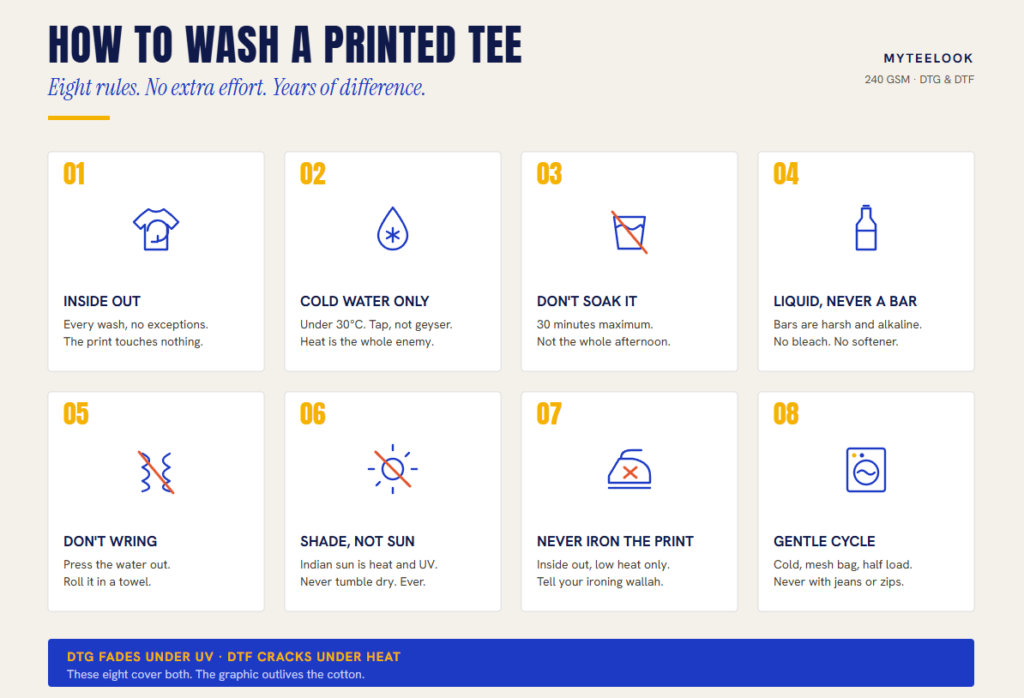
It’s also why they need washing alone for the first few cycles. The care guide covers that.
What we use
Our tees run 180–240 GSM cotton, depending on the piece.
We’d rather give you a range that’s true than a single number that’s tidy. A lighter basic and a heavy oversized tee are different garments with different jobs, and pretending they weigh the same would be the exact thing this post is complaining about.
We don’t claim Supima, because we’re not licensed and it wouldn’t be true. We don’t say “premium cotton”, because it means nothing. We tell you the weight and we tell you the print method, and that’s more than you’ll get from most.
What to ask instead of “what types of cotton do you use?”
Four questions that cut through all of it:
- What’s the fibre composition? “100% cotton” or a percentage split. If they dodge, it’s a blend.
- What’s the GSM? Weight. Covered here.
- Combed or carded? Combed removes the short fibres. It’s the cheapest real quality upgrade there is.
- What’s the print method? DTG, DTF, screen, embroidery — they fail differently.
Any brand that can’t answer all four doesn’t know what it’s selling.
Frequently asked questions
⚙️ Rebuild with the Rank Math FAQ block.
What are the main types of cotton? By staple length: upland cotton (~28mm, about 80% of world production), long staple, and extra-long staple or ELS (30mm+). ELS is a different species — Gossypium barbadense rather than hirsutum. Pima, Supima, Egyptian and Suvin are all ELS varieties.
Is Supima cotton better than regular cotton? Yes — it’s extra-long staple, around 34mm against upland’s 28mm, so it’s smoother, stronger and pills less. But Supima is a licensed trademark for American-grown Pima specifically. Only licensed brands can use the name, and you can check the licensee list at supima.com.
Is terry cotton good quality? “Terry cotton” doesn’t describe quality, or reliably describe fibre. Terry is a looped knit that can be cotton, polyester or a blend. In India, “Terrycot” specifically means a polyester-cotton blend. Ask for the composition instead.
What is acid-washed cotton? Not a cotton type — a finishing process applied to a finished garment. Abrasives and oxidising agents strip dye unevenly, so each piece is unique. It’s mildly abrasive to the fabric, so it suits heavier weights better.
Which cotton is best for t-shirts in India? Combed, ring-spun upland cotton at 220–240 GSM covers almost every real use. ELS is lovely and mostly wasted on a graphic tee. Fibre quality matters far less than weight and construction for how a t-shirt actually behaves.
What is Suvin cotton? An Indian ELS variety grown in Tamil Nadu, created by crossing Sujata with Sea Island cotton from St. Vincent. Its 38–40mm staple is longer than Supima’s or Egyptian’s, making it among the finest cotton in the world. Production has collapsed from roughly 40,000 bales in the 1980s to around 1,500.
The short version
The four words aren’t four types of cotton. Supima is a fibre grade and a trademark. Terry is a knit. Acid wash is a finish. Only one of them is even on the fibre layer.
Forget comparing types of cotton by name. Ask for composition, weight, and how the yarn was spun. Everything else on a label is decoration.
The fabric weight guide is the one that actually changes what you buy — or browse the range.