A print doesn’t crack because it was cheap. It cracks because of what happened to it on a Sunday afternoon in a bucket.
I’ve seen a ₹1,200 tee destroyed in a month and a ₹500 one hold up for four years, and the difference was almost never the printing. It was the water temperature, the sun, and a man with a very hot iron.
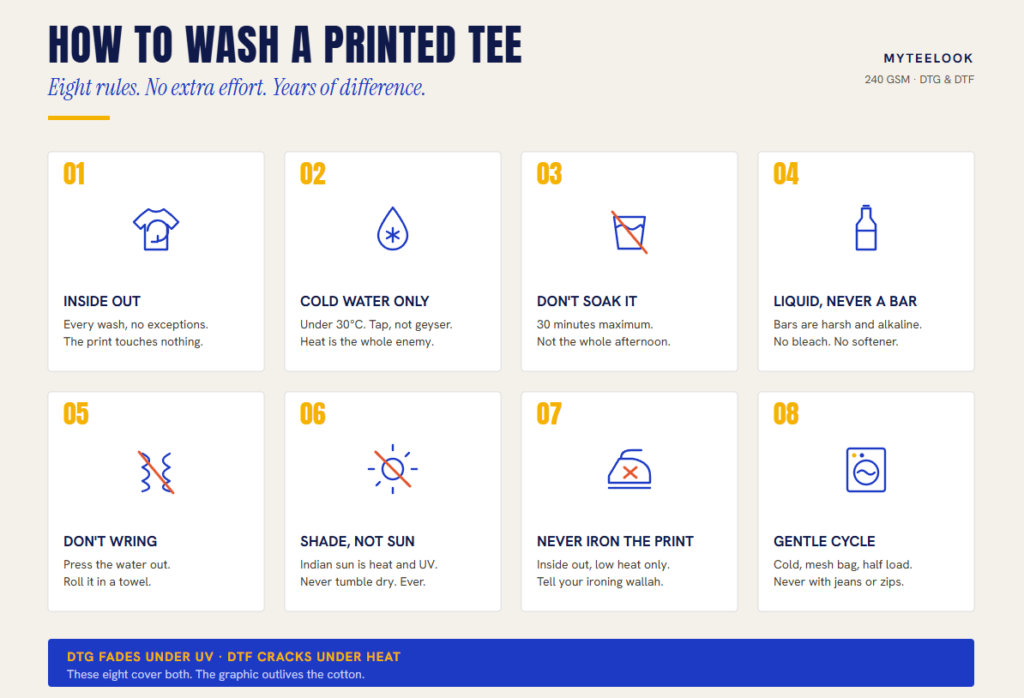
Here’s how to wash printed t-shirts properly — eight habits that cost nothing and buy years.
Table of Contents
Why prints fail when you wash printed t-shirts wrong
Worth thirty seconds, because it makes everything below obvious — and because the honest answer is it depends which method printed your shirt.
We run both. They fail in completely opposite ways, and almost nobody tells you this.
DTG (direct-to-garment) sprays water-based ink directly into the cotton fibres. The ink becomes part of the fabric rather than sitting on it. DTG barely cracks at all — it fades. Its enemies are UV light, bleach, and repeated hot water slowly washing pigment out.
DTF (direct-to-film) presses a printed film onto the fabric using heat and an adhesive powder. That film sits on top as a thin flexible layer. DTF is the one that cracks and peels, and it always starts at the edges. Its enemy is heat — because heat is exactly what bonded it there, and enough heat will unbond it.
So the rules below are really three rules wearing eight hats:
- Avoid heat. It lifts DTF and ages DTG.
- Avoid UV. It fades DTG fastest.
- Reduce abrasion. Both suffer.
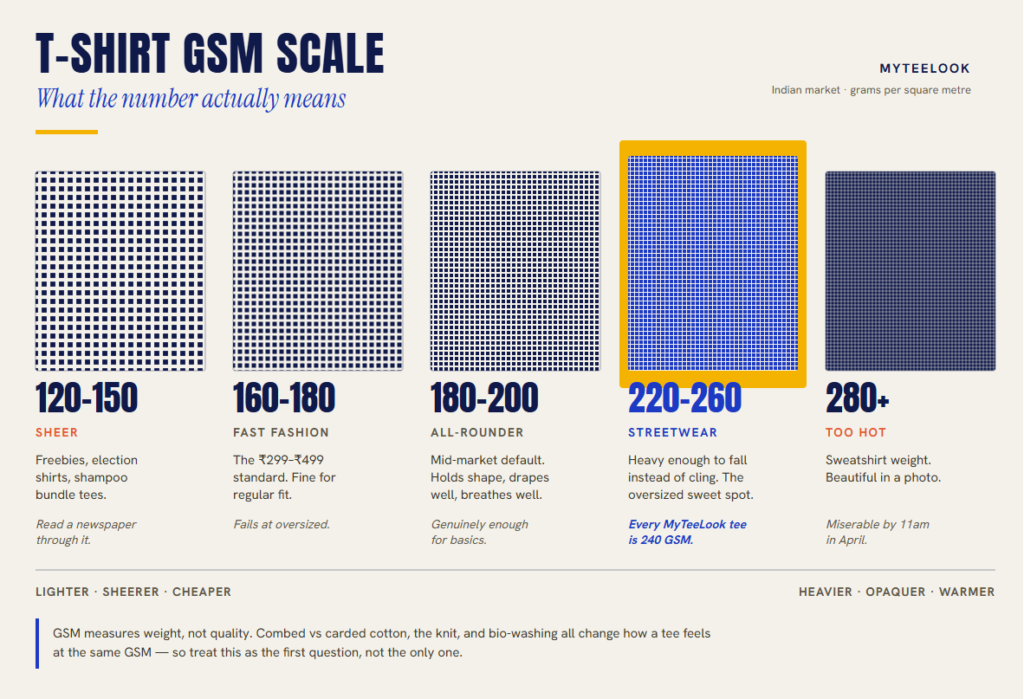
There’s a fabric angle underneath all of it. Heavier cotton flexes less under agitation, which is one reason a 240 GSM tee holds a print longer than a 160 GSM one — the GSM guide covers why that weight matters before you even reach the wash.
⚙️ Image — the DTG vs DTF diagram (supplied as SVG).
Alt: DTG vs DTF cross section showing how to wash printed t-shirts by print type
Which print is on your shirt — and does it change how you wash printed t-shirts?
Run a fingernail across the edge of the graphic.
- Feels like nothing. The print is the fabric, matte, weave visible through it. That’s DTG. Expect gradual softening, not flaking.
- Feels like a thin raised edge, slight sheen, sitting just above the cotton. That’s DTF. Protect the edges and keep heat away from it.
1. Wash printed t-shirts inside out. Every single time.
The cheapest, highest-return habit on this list.
When you wash printed t-shirts inside out, the print never touches the bucket, the drum, another garment, or your washing stone. All the abrasion happens on the inside of the shirt, where there’s nothing to damage.
If you do nothing else on this page, do this one.
2. Wash printed t-shirts in cold water only
Heat is the enemy. Not warm — cold.
Under 30°C, which in most of India means straight from the tap for most of the year. Hot water softens the ink binder while the fabric is being agitated, and that combination is what turns a hairline crack into a missing chunk.
This is also why your geyser is not your friend in winter. You can wash printed t-shirts perfectly well in cold water; detergent does the actual work.
3. Never soak printed t-shirts for hours
This one’s specific to how we actually wash things here.
The way most of us wash printed t-shirts here — the standard bucket routine — dump everything in with detergent, go have lunch, come back in two hours — is fine for a plain shirt and slowly fatal for a printed one. Prolonged saturation works on the adhesive layer between ink and fibre.
Thirty minutes maximum. Fifteen is plenty.
4. Wash printed t-shirts with liquid detergent, never a bar
Detergent bars are highly alkaline and abrasive by design. They’re built to be scrubbed against fabric, which is precisely the thing you’re trying to avoid.
Use a mild liquid detergent. Skip bleach entirely — it’s the fastest way to strip a DTG print, since the pigment is sitting in the fibre where bleach does its work — skip anything marketed as a “power” or “stain-attack” formula, and skip fabric softener too — it coats fibres and can lift print edges over time.
On hard water: much of India has it, and hard water leaves mineral residue that dulls prints and stiffens fabric. If your soap won’t lather properly, that’s your answer. A spoon of washing soda in the bucket helps, or a water softener if it’s bad in your area.
5. Never wring or twist printed t-shirts
Wringing is concentrated mechanical stress applied exactly where you don’t want it.
Press the water out instead. Roll the shirt in a towel and press. If you’re using a machine, the spin cycle is fine — it’s the two-handed twist that does the damage.
6. Dry printed t-shirts in shade, not sun
The one everyone gets wrong, and the one that matters most in this country.
Direct Indian sun is a heat gun and a UV lamp at once — which is unlucky, because that’s one weapon for each print type. The heat works on DTF’s adhesive; the UV bleaches DTG’s pigment. A tee that would’ve lasted three years lasts one summer.
Always dry printed t-shirts inside out, in shade, ideally with some breeze. It takes an hour longer and buys you years. If you must use sun, inside out is non-negotiable — let the sun hit the back of the print, not its face.
Never tumble dry. It’s heat and flex at the same time. It’s the single fastest way to destroy a print that exists.
7. Tell your ironing wallah
Nobody thinks about this and it kills more prints than washing does.
The ironing wallah’s press runs hot — much hotter than a home iron — and if he puts it directly on your graphic, that print is gone in one pass. Melted, shiny, done.\n\nThis is existential for DTF. That film was bonded at around 160°C. A domestic iron reaches 200°C and a commercial press goes higher, so ironing a DTF print doesn’t just damage it — it re-melts the adhesive and the graphic lifts. There’s no recovering from it.
Two options: tell him to iron it inside out, or fold the print in and iron around it. If you’re doing it yourself, inside out, low heat, or lay a cotton cloth over the print and iron through that. Never steam directly onto a graphic.
8. Machine wash printed t-shirts on gentle only
Gentle or delicate cycle. Cold. Inside out. Mesh laundry bag if you have one.
Wash printed t-shirts with soft things — other tees, cotton. Not with jeans, not with anything carrying zips, hooks or buttons. A single zip tumbling against a print for forty minutes does visible damage.
Half-load the drum. Crowded drums mean more friction, and friction is what finds a DTF edge.
Wash printed t-shirts differently if they’re acid washed
Slightly different animal. Acid-washed tees have already been through a chemical process, so the fabric surface is more open than a standard tee.
Wash printed t-shirts of this kind alone for the first two or three cycles — they can transfer colour. After that, the same rules apply.
The first wash printed t-shirts get matters most
Cotton does most of its shrinking in the first wash, and shrinkage means the fabric moves under a print that isn’t moving with it.\n\nDTG prints have a second reason. Dark garments need a pretreatment liquid before printing, and traces of it stay in the fabric. The first cold wash clears that residue — which is also why a brand-new DTG tee can look very slightly hazy around the graphic until it’s been washed once. That’s not a defect. It rinses out.
Wash printed t-shirts cold and inside out for thirty minutes, then shade dry. Get the first one right and the shirt settles into its shape with the print intact.
Frequently asked questions
How do you wash printed t-shirts without ruining the print?
Inside out, cold water, mild liquid detergent, no soaking beyond thirty minutes, no wringing, and line dry in shade. Heat and abrasion cause nearly all print damage — remove both and prints last for years.
Can you machine wash printed t-shirts at home?
Yes. Gentle cycle, cold water, inside out, in a mesh bag if possible. Wash them with other soft cotton items, never with jeans or anything with zips.
Why is my t-shirt print cracking after a few washes?
Usually heat: hot water, tumble drying, direct sun, or an iron on the print. Thin fabric makes it worse, because it flexes more under the ink. If it cracked within two or three washes despite cold care, that’s a printing defect, not a care issue.
Can you iron a printed t-shirt?
Only inside out, or with a cotton cloth over the print, on low heat. Never directly on the graphic and never steam onto it. Tell your ironing wallah — his press is much hotter than yours.
Does fabric softener damage prints?
It can. Softeners coat fibres and can work into the edges of a print over time. Skip it on graphic tees.
Should you wash a new printed t-shirt before wearing it?
Yes, once, cold and alone. It clears surface dyes and lets the cotton do its initial shrink before the shirt has moulded to you.
The short version
Inside out. Cold. Thirty minutes. No wringing. Shade, not sun. Nothing hot ever touches the print.
Wash printed t-shirts that way and the graphic outlives the cotton. Six habits, no extra cost, no extra effort once they’re automatic. Our spiritual and anime prints are built to survive normal life, but nothing survives a hot iron.
Still deciding what to buy? The fabric guide explains why weight decides print longevity — or just browse the range.