You are not hot because of the temperature. You’re hot because your sweat has nowhere to go.
This is the thing almost every “best summer fabric” article gets wrong before its first paragraph ends. Sweat doesn’t cool you. Sweat evaporating cools you — the phase change pulls heat off your skin. In dry heat that works brilliantly. In humid heat, the air is already close to saturated, so evaporation slows to a crawl and you just sit there, wet.
Sirsi in July isn’t Jaisalmer in May. Same thermometer, completely different problem.
So the real question isn’t which fabric for humid weather feels coolest in the shop. It’s which one lets water leave.
Table of Contents
How to judge any fabric for humid weather
One number does most of the work: moisture regain — how much water a fibre holds at equilibrium, as a percentage of its dry weight. It’s a standard textile measure, and it splits fibres into two camps.
Hydrophilic fibres — cotton, linen, viscose, silk, wool — have polar groups in their molecular structure that hydrogen-bond with water. They soak it up.
Hydrophobic fibres — polyester, acrylic, nylon — don’t. Their molecular chains are non-polar, so water moves through them by capillary action between the yarns rather than into the fibre itself.
Neither camp automatically wins. For a fabric for humid weather, absorbing sweat is good only if it then releases it. It’s terrible if the fabric just holds it against you. That distinction is the whole game.
The six: every fabric for humid weather, ranked
1. Linen — the honest winner
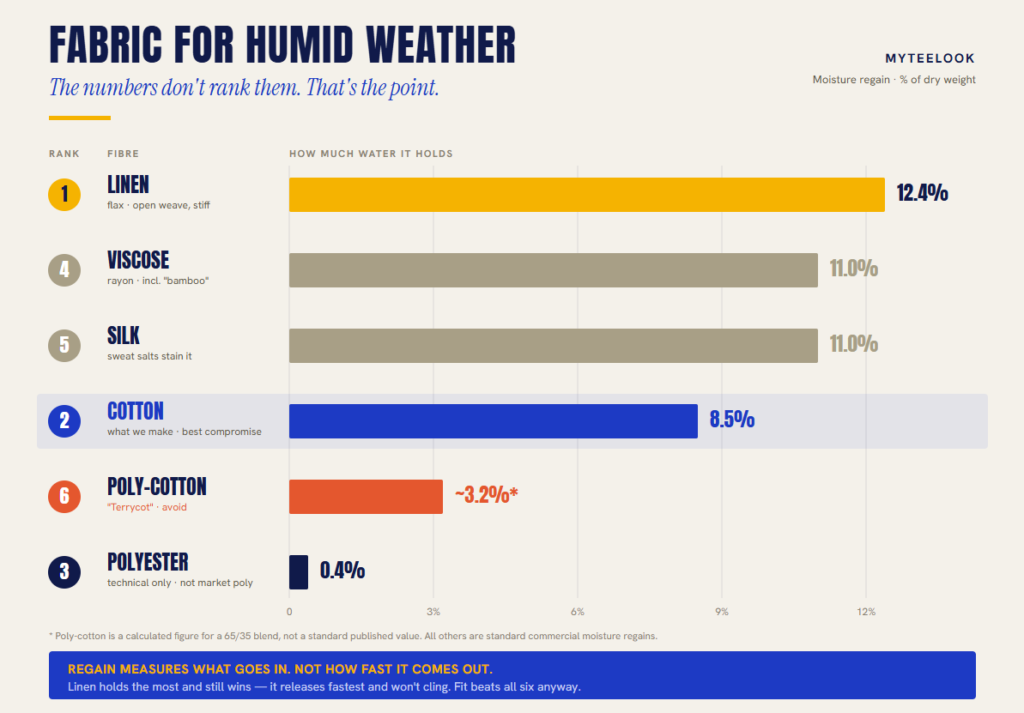
Moisture regain 12.4%. Higher than cotton, and yet it’s still the best fabric for humid weather by a distance.
Why? Two reasons that have nothing to do with absorption. Linen’s fibres are hollow and its weave is open, so it releases moisture almost as fast as it takes it on. And it’s stiff — it doesn’t cling. It stands off your skin and holds an air gap, and that gap is where evaporation actually happens.
The wrinkles everyone complains about are a side effect of the exact property that makes it work.
2. Cotton — good, not great, and everywhere
Regain 8.5%. Cotton absorbs sweat readily, which feels great for the first twenty minutes.
Then it’s holding it. Wet cotton clings, stops breathing, and dries slowly — in humid air, very slowly. This is why a cotton tee is perfect in Delhi in April and miserable in Mangalore in July at the same temperature.
Cotton isn’t the best fabric for humid weather. It’s the best compromise: breathable, cheap, soft, dyes well, doesn’t smell. That’s why it’s everywhere, and it’s a legitimate reason.
3. Technical polyester — better than its reputation
Regain 0.4%. It barely absorbs anything, so it wicks moisture to the surface where it can evaporate.
Engineered properly, that’s genuinely good in humidity — which is why sportswear is polyester and not cotton. The catch is that “polyester” covers both a ₹3,000 running shirt and a ₹150 market tee, and the second one traps heat, doesn’t breathe, and smells within an hour because bacteria love a surface that won’t absorb.
Ranked third with an asterisk. As a fabric for humid weather, good polyester beats cotton. Bad polyester loses to everything.
4. Viscose / rayon — feels cool, isn’t
Regain 11%. It’s regenerated cellulose, drapes beautifully, and feels cold to the touch in the shop.
That coolness is thermal conductivity, not breathability, and it lasts about ten minutes. Viscose absorbs a lot, releases slowly, clings when damp, and loses significant strength when wet. As a fabric for humid weather it flatters to deceive.
Bamboo fabric is usually viscose made from bamboo pulp. Same fibre, better marketing.
5. Silk — beautiful, impractical
Regain 11%. Lovely hand, genuinely cool against skin, and then sweat salts stain it and degrade the protein over time.
It’s not that silk performs badly. It’s that you’ll be anxious the entire time you wear it.
6. Poly-cotton blend — the worst of both
Here’s the one to actually avoid.
You get cotton’s absorption and polyester’s refusal to breathe. It holds sweat like cotton and traps heat like cheap poly. In India this is often sold as “Terrycot” — Terylene plus cotton, typically 65/35 — and the name sounds like a fabric rather than a compromise. The cotton guide covers why that label is designed to confuse.
Why picking a fabric for humid weather is the wrong first question
Everything above is real, and choosing a fabric for humid weather is roughly the fourth most important decision you make.
In order of what actually determines whether you’re comfortable:
- Fit — by a mile
- Weight — GSM
- Weave or knit — how open the structure is
- Fibre — everything you just read
A loose 180 GSM cotton tee outperforms a fitted linen shirt in Sirsi in July. Not because cotton beat linen — it didn’t — but because fit beat fibre, and it wasn’t close.
Why fit beats any fabric for humid weather: the air gap
Evaporation needs somewhere for the water vapour to go.
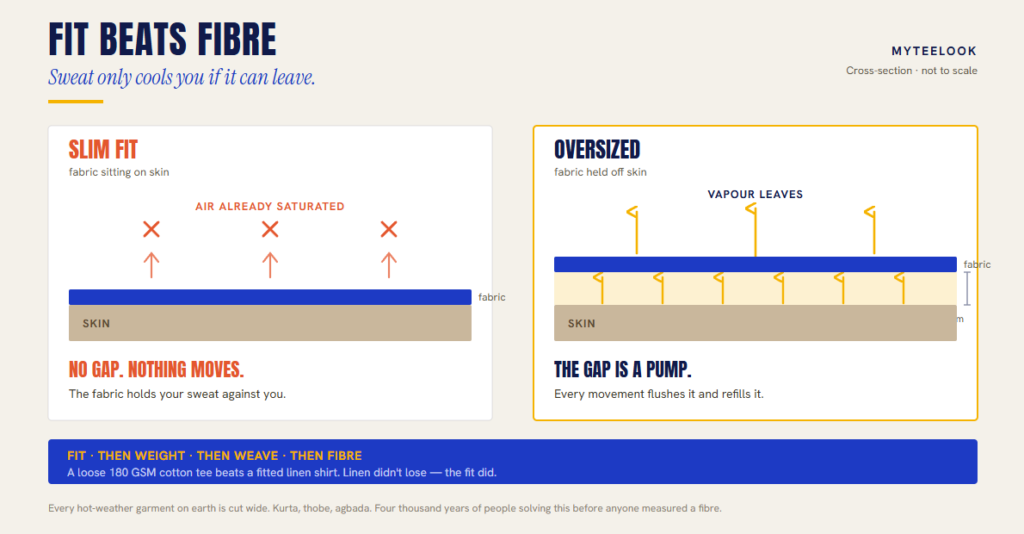
Any fabric for humid weather touching your skin has no gap. The sweat wets the fabric, the fabric holds it against you, and the humid air above it is already saturated. Nothing moves. You are, functionally, wearing a warm compress.
Fabric held a centimetre off your skin creates a pocket where air can move, vapour can rise, and evaporation can actually occur. Every time you move, that pocket flushes and refills. It’s a pump.
This is the entire reason loose clothing works in hot climates, and why every hot-weather traditional garment on earth — kurta, thobe, agbada — is cut wide rather than fitted. Four thousand years of people solving this before anyone measured moisture regain.
Which means an oversized cut isn’t just a look. The oversized fit is doing real thermodynamic work in a Karnataka July, and a slim-fit tee in the same fabric is not.
Weight: what your fabric for humid weather costs you in July
Second variable, and the one nobody publishes.
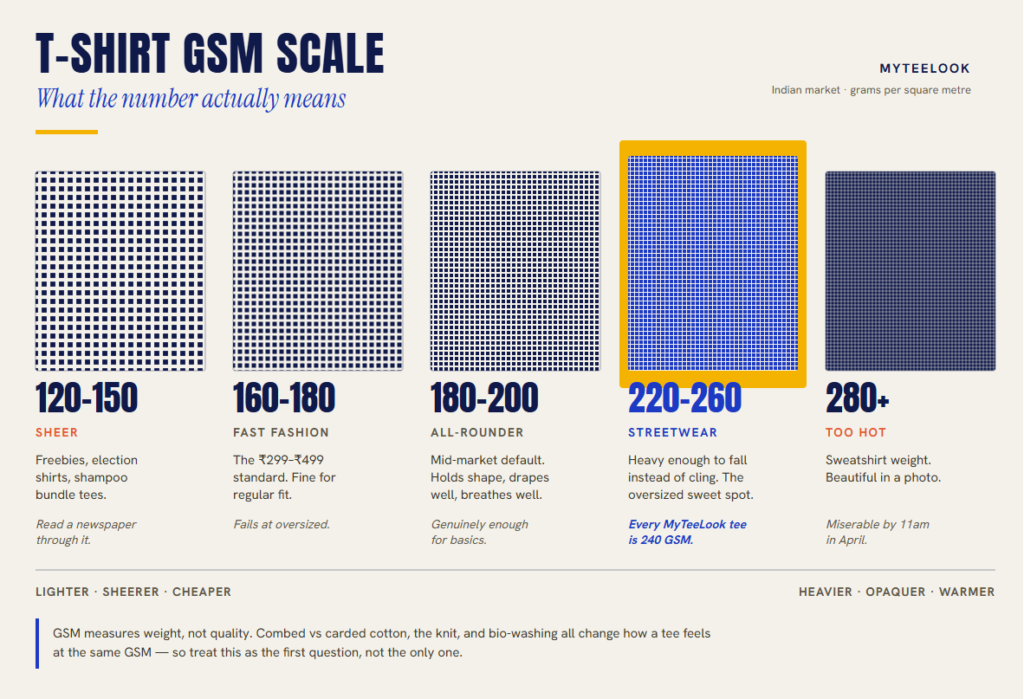
A 240 GSM tee has more cotton in it than a 180 GSM tee. More cotton holds more water and takes longer to dry. In dry heat that’s a fair trade for structure and opacity. In humidity, it’s a real cost.
Our tees run 180–240 GSM depending on the piece, and this is exactly why the range exists rather than one number. A heavier oversized tee holds its drape; a lighter basic dries faster. Neither is the correct answer to every month of the year.
The GSM guide explains what the number means. This is what it costs you in July.
The fabric for humid weather we don’t sell
We sell cotton. Linen is a better fabric for humid weather than cotton, and no amount of writing changes that.
We don’t make linen tees because you can’t. Linen doesn’t take a DTG or DTF print the way cotton does, it doesn’t hold an oversized drape, it costs several times more, and a linen graphic tee is a garment nobody has asked for. Those are honest reasons and they’re also convenient ones. Both things are true.
If you’re dressing for a Konkan monsoon and comfort is the only variable, buy a loose linen shirt. If you want a graphic tee that survives a Karnataka summer, buy a light one and buy it loose.
Choosing a fabric for humid weather: what to actually do
- Buy loose. The single highest-impact decision. Fit beats fibre.
- Buy light in summer. 180 GSM in July, 240 GSM the rest of the year.
- Avoid blends. Poly-cotton is the one genuinely bad answer here.
- Check the composition, not the name. “Terrycot”, “premium cotton” and “breathable fabric” are not specifications.
- Cotton is fine. As a fabric for humid weather it isn’t optimal. It’s the best compromise ever invented, which is a different and more useful thing.
Frequently asked questions
What is the best fabric for humid weather?
Linen. Its open weave and stiffness release moisture fast and hold the fabric off your skin, which is where evaporation actually happens. Cotton is second and far more practical for everyday clothes.
Is cotton good for humid weather?
It’s good, not best. Cotton absorbs sweat well (8.5% moisture regain) but releases it slowly, so it stays damp and clings in humid air. Light and loose cotton is genuinely comfortable; heavy and fitted cotton is not.
Is polyester bad in humid weather?
Depends entirely on the polyester. Technical polyester barely absorbs water (0.4% regain), so it wicks sweat to the surface to evaporate — which is why sportswear uses it. Cheap polyester traps heat, doesn’t breathe, and smells. The word covers both.
Why does viscose feel cool but get uncomfortable?
Viscose feels cold on contact because it conducts heat away quickly, which has nothing to do with breathability. It absorbs a lot (11%), releases slowly, and clings when damp. The first impression doesn’t survive an afternoon.
Is linen or cotton better for Indian summers?
Linen for pure comfort in humidity. Cotton for everything else — cost, softness, printability, durability. In dry heat the gap narrows considerably.
Does GSM matter more than fabric type in summer?
Fit matters most, then weight, then weave, then fibre. A loose 180 GSM cotton tee beats a fitted linen shirt. Fibre is the last variable, not the first.
The short version
Humidity blocks evaporation. Evaporation is the only cooling you get.
Linen is the best fabric for humid weather. Cotton is the best compromise. Poly-cotton is the trap. And none of that matters as much as buying it loose and buying it light, because the air gap between fabric and skin does more work than the fibre ever will.
The GSM guide covers weight, and the cotton guide covers what the labels hide. Or browse the oversized range, which is loose for reasons that predate fashion.