There’s a t-shirt in your cupboard that you bought a size up, hoping it would look oversized. It doesn’t. It looks like it belongs to someone taller than you.
That’s not a sizing failure. It’s a pattern failure, and no size on the label would have fixed it.
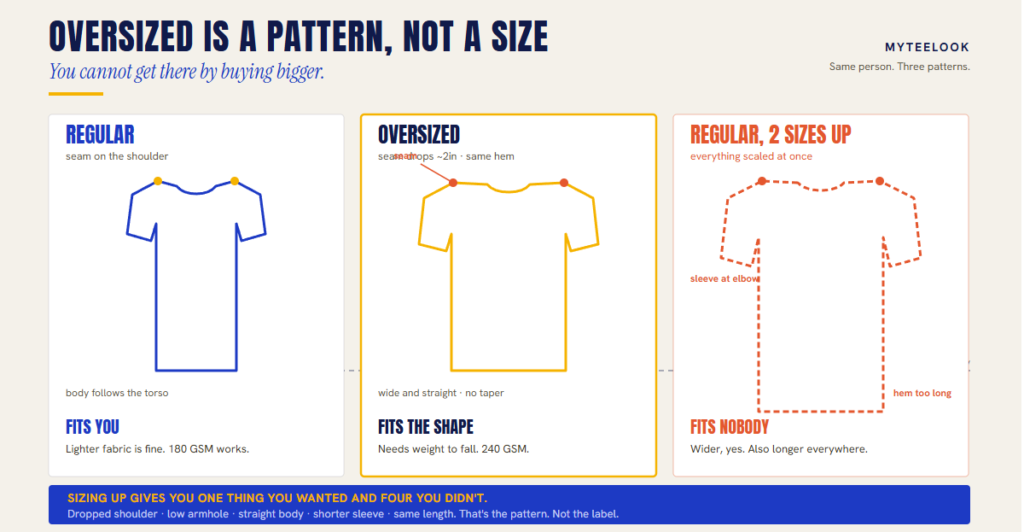
The oversized vs regular question gets answered as though it’s about numbers — buy the M or buy the L. It isn’t. Oversized vs regular is two different garments cut from two different patterns, and one cannot be turned into the other.
Table of Contents
Oversized vs regular: the five real differences
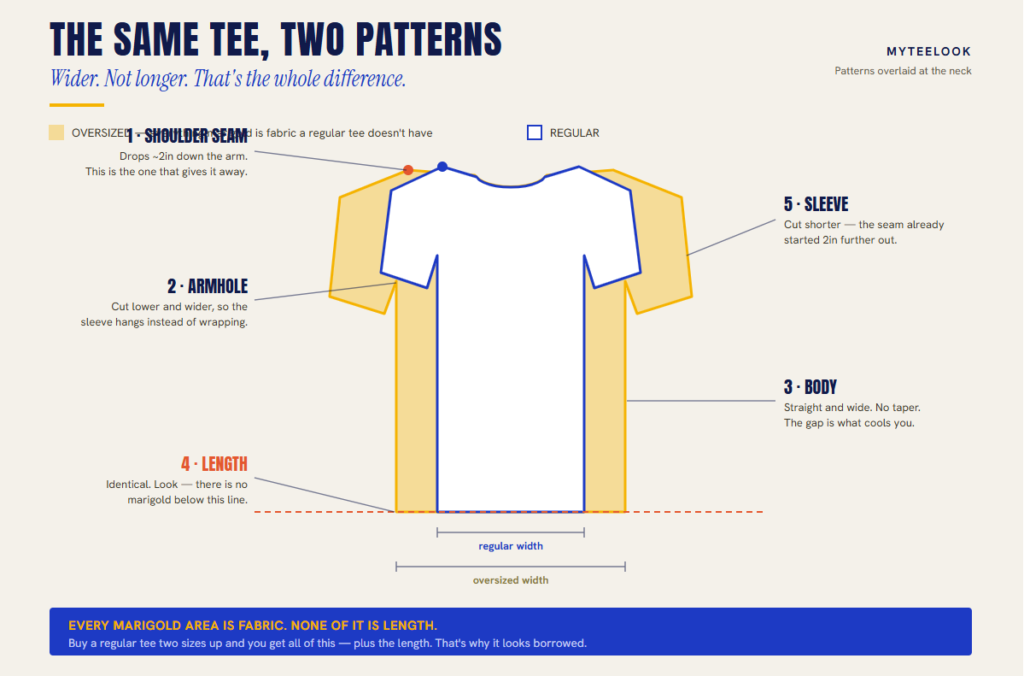
Every oversized vs regular difference below is designed in at the pattern stage. None of it is size.
1. The shoulder seam: the oversized vs regular tell
Regular: the seam sits on your shoulder point, where your arm actually starts. Oversized: the seam sits roughly two inches down your upper arm. On purpose. It’s called a drop shoulder.
This is the single tell. Look at any tee on a hanger and find the seam. Everything else about the oversized vs regular difference follows from this one decision.
2. The armhole
Regular: high and narrow, cut close to your armpit. Oversized: dropped low and cut wide, so the sleeve hangs rather than wraps.
You feel this before you see it, and it’s the oversized vs regular difference your body notices first. A low armhole is why an oversized tee doesn’t pull when you raise your arm.
3. Body width
Regular: follows your torso with some ease. Tapers slightly, or at least doesn’t flare. Oversized: straight and wide from chest to hem. No taper at all.
The width is why the oversized cut hangs instead of touching. That gap is also why it works in a Karnataka July — air moving between fabric and skin is the only cooling you get, and a fitted tee doesn’t give you any.
4. Length: the counterintuitive oversized vs regular difference
Here’s what surprises people.
A true oversized tee is not proportionally longer than a regular one. It’s wider, and roughly the same length — often ending around your mid-fly, same as a well-fitting regular.
That’s the whole trick. Wide but not long reads as deliberate. Wide and long reads as borrowed.
5. The sleeve
Regular: sleeve length is calculated from the shoulder point. Oversized: the seam already sits two inches down your arm, so the sleeve is cut shorter to compensate.
A well-cut oversized sleeve ends around mid-bicep. If yours reaches your elbow, the pattern wasn’t drafted — it was scaled.
The big oversized vs regular mistake: sizing up never works
This is the oversized vs regular error almost everyone makes, and it’s worth understanding rather than just avoiding.
When you buy a regular tee two sizes up, the manufacturer’s grading rules scale everything proportionally. So you get:
- A wider body — good, that’s what you wanted
- A longer body — bad, now it’s a nightshirt
- A shoulder seam halfway down your bicep — but the sleeve is also longer, so it reaches your elbow
- An armhole that’s bigger but still cut at the wrong angle
- A neck opening that’s wider than your neck
Four of those five are wrong. You bought one desirable trait and four defects bundled with it.
An oversized pattern gives you the width without any of the rest. That’s what you’re paying a designer for.
Why oversized vs regular is also a fabric weight decision
The oversized vs regular choice is also a fabric choice, which is the part nobody explains.
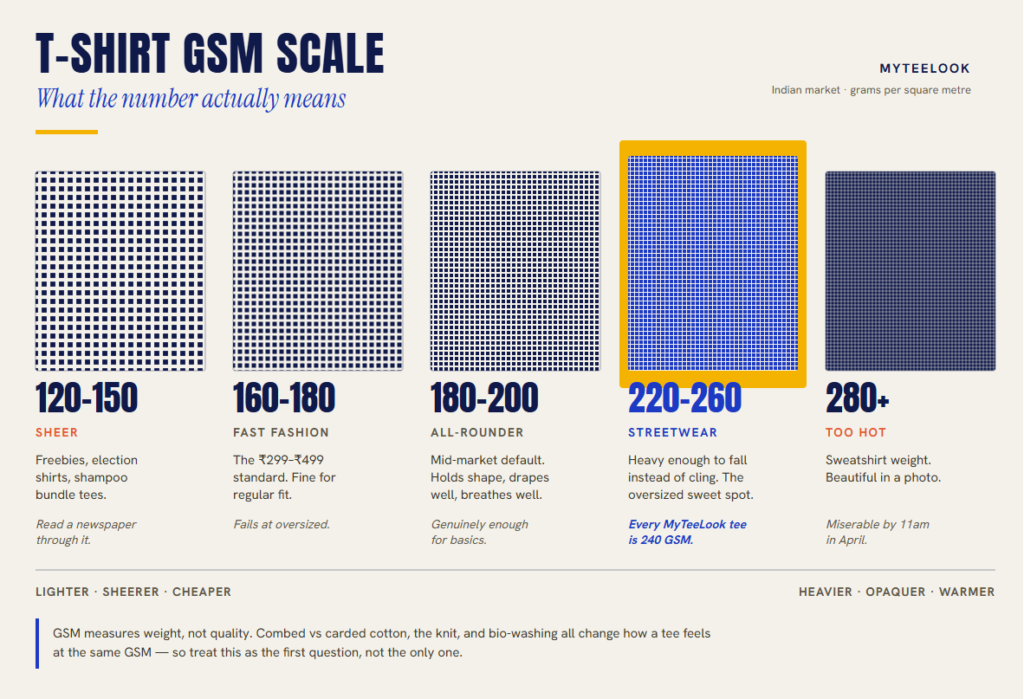
An oversized cut needs weight. The whole silhouette depends on fabric falling away from your body under its own mass. Cut an oversized pattern in thin 160 GSM cotton and it doesn’t fall — it drapes limply and clings at every contact point. The shape collapses.
A regular cut doesn’t. It’s following your body anyway, so lighter fabric is fine and often better — it breathes more and dries faster.
This is exactly why our tees run 180–240 GSM depending on the piece rather than one flat number. The GSM guide explains what the number means; the short version is that a light basic and a heavy oversized tee are solving different problems and shouldn’t weigh the same.
Oversized vs regular: which should you buy?
Honestly, and without pretending one is better.
Buy regular if:
- You want something that disappears under a shirt or jacket
- You’re dressing somewhere with a dress code
- You run hot and want the lightest possible fabric
- You genuinely prefer clothes that follow your body
Buy oversized if:
- The graphic is the point and you want it to have room
- You want airflow in humidity — the gap is doing real work
- You want the shape to be the statement rather than your body
- You’re layering it under an open overshirt
Oversized vs regular is not a body type question. The advice that shorter guys can’t wear oversized is wrong — the actual rule is hem at mid-fly and a front half-tuck, both of which raise your visible waist. Length is the variable, not height.
Oversized vs regular: how to check before you buy
Product photos lie about fit. Measurements settle the oversized vs regular question in ten seconds.
- Ask for chest width flat, not “size L”. Measure a tee you already like, armpit to armpit, lying flat. Compare numbers.
- Ask for length from HPS — high point shoulder, the top of the shoulder seam by the neck. It’s the only length measurement that means anything.
- Look at the hanger photo, not the model. A thin oversized tee collapses inward at the shoulder because there’s nothing holding the line.
- Check the seam. Two inches off the shoulder is oversized. On the shoulder is regular. Halfway down the bicep is a mistake.
The oversized silhouette came out of 90s hip-hop and skate culture, where it was function before it was fashion — clothes people could actually move in. The proportions weren’t invented by a brand. They were worked out by wearers.
Frequently asked questions
What is the difference between oversized and regular fit t-shirts?
Pattern, not size. An oversized tee has a dropped shoulder seam sitting about two inches down the arm, a low wide armhole, a straight untapered body, and a shorter sleeve — while staying roughly the same length as a regular. A regular fit follows your torso with the seam on your shoulder point.
Can I just buy a regular t-shirt two sizes up?
No. Grading scales everything, so you get the extra width you wanted plus extra length, a sleeve reaching your elbow, and a neck opening too wide. Four defects for one benefit. It reads as borrowed rather than intentional.
Is oversized or regular better for Indian summers?
Oversized, usually. The gap between fabric and skin lets sweat evaporate, which is the only cooling mechanism you have in humidity. A fitted tee holds the sweat against you.
How long should an oversized t-shirt be?
Around mid-fly. Not mid-thigh. A true oversized cut is wide, not long — the width is the design, the length staying normal is what stops it looking like a dress.
Do oversized t-shirts need heavier fabric?
Yes. The silhouette depends on fabric falling away from the body, which needs mass. 220–240 GSM behaves; 160 GSM in an oversized pattern just clings and loses shape.
Can short guys wear oversized t-shirts?
Yes. Keep the hem at mid-fly or above and half-tuck the front. Both raise your visible waistline, which is what creates height. The problem is never the fit, it’s the length.
The short version
Oversized vs regular isn’t a size decision. It’s a different pattern: dropped shoulder, low armhole, straight body, shorter sleeve, same length.
You cannot get there by buying up. You get the width and four defects.
The GSM guide covers why the two fits need different fabric weights. Or compare them directly — oversized and basics.