GSM t-shirt meaning, in one line: it’s the weight of the fabric, and it’s the single number that decides whether your tee holds its shape for three years or turns sheer in three washes.
I bought a t-shirt off an Instagram ad two years ago. ₹299, free delivery, a print I actually liked. It arrived on a Tuesday. By the third wash the shoulders had grown wings, the neck had given up entirely, and if I stood in front of a window you could see my entire life story through the back of it.
The listing said “premium cotton.” It did not say 140 GSM. That number was the whole story, and nobody tells you the whole story.
So let’s fix that.
Table of Contents
GSM t-shirt meaning, in plain language
GSM stands for grams per square metre. That’s it. Take one metre of the fabric, cut a perfect square, put it on a weighing scale. Whatever it weighs in grams is the GSM. It’s a standard textile measurement called grammage, used across paper and fabric alike.
A 180 GSM t-shirt uses 180 grams of cotton per square metre. A 240 GSM t-shirt uses 240 grams for the same area. More grams means more yarn packed into the same space, which means a denser, heavier, more opaque fabric.
The GSM t-shirt number is a measure of weight. Not softness. Not quality. Not durability. Weight.
Hold that thought, because half the internet gets this wrong.
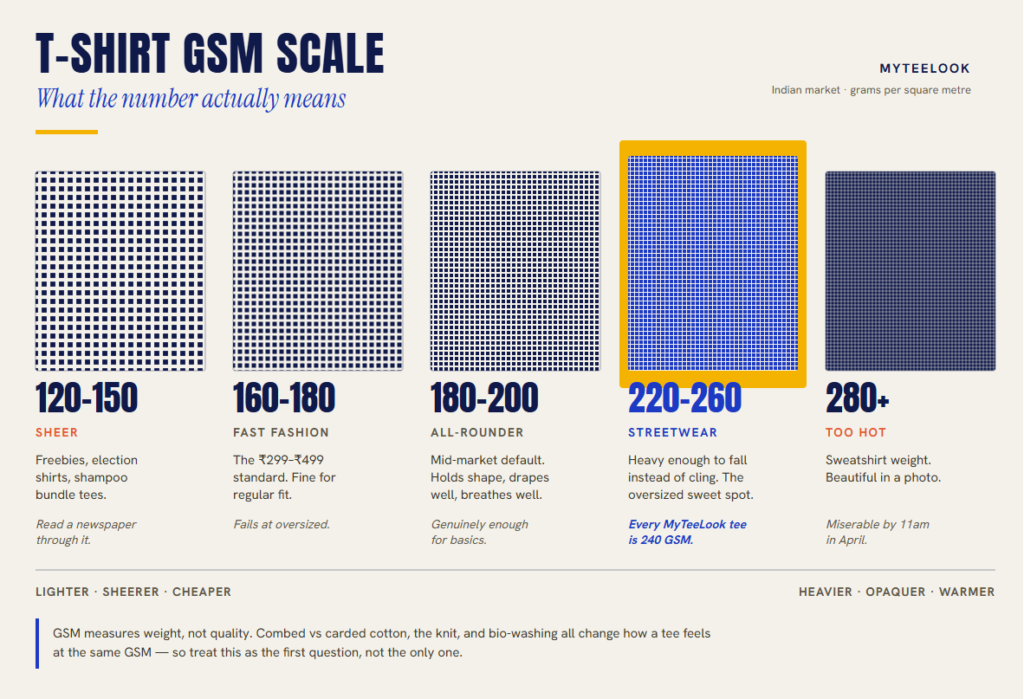
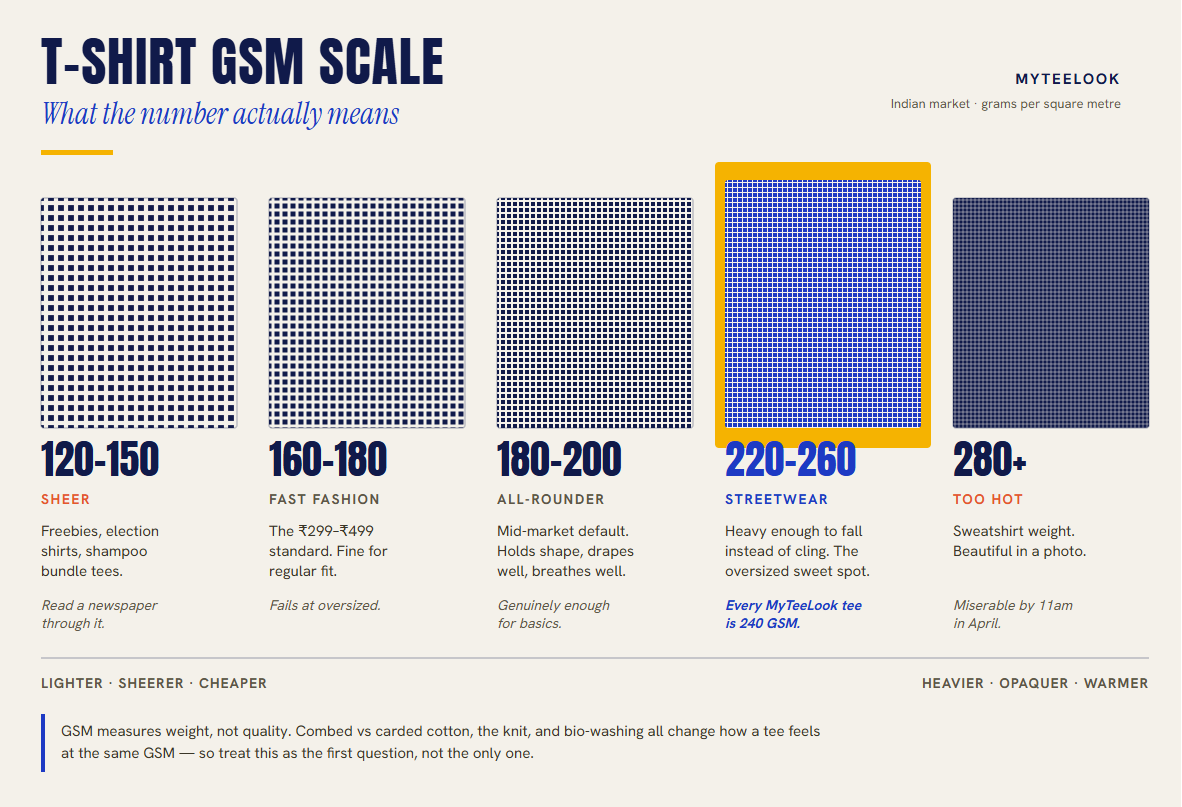
GSM t-shirt chart for the Indian market
Every mill fudges these slightly, but this is close enough to be useful:
| GSM | What it is | Verdict |
|---|---|---|
| 120–150 | Airport freebies, election shirts, the kind that comes free with a shampoo bottle | Genuinely sheer. Avoid. |
| 160–180 | Standard for most ₹299–₹499 fast-fashion tees | Fine for regular fit. Fails at oversized. |
| 180–200 | Decent everyday territory, where most mid-market brands live | Solid all-rounder. |
| 220–260 | Where a GSM t-shirt starts behaving like proper streetwear | The oversized sweet spot. |
| 280+ | Sweatshirt weight | Beautiful in a photo. Miserable in April. |
If you’re shopping for plain everyday basics, 180 is genuinely enough. If you want an oversized fit, you need the weight — and that’s not upselling, it’s physics. A drop shoulder needs fabric heavy enough to fall.
Why cheap tees are always thin
Cotton is sold by weight. That is the entire explanation for why a cheap GSM t-shirt is a thin one.
Dropping a tee from 240 GSM to 160 GSM removes roughly a third of the raw material from every single unit. Multiply that across ten thousand pieces and it’s a serious number on someone’s spreadsheet.
The print looks identical in the product photo. The listing still says cotton, because it is cotton. Nobody’s technically lying.
You only find out in your bucket, three washes later.
5 proven ways to spot a thin tee
Most Indian listings don’t mention GSM at all, which should tell you something. When the number’s missing, here’s how to read the shirt itself.
1. Hold it up to a light
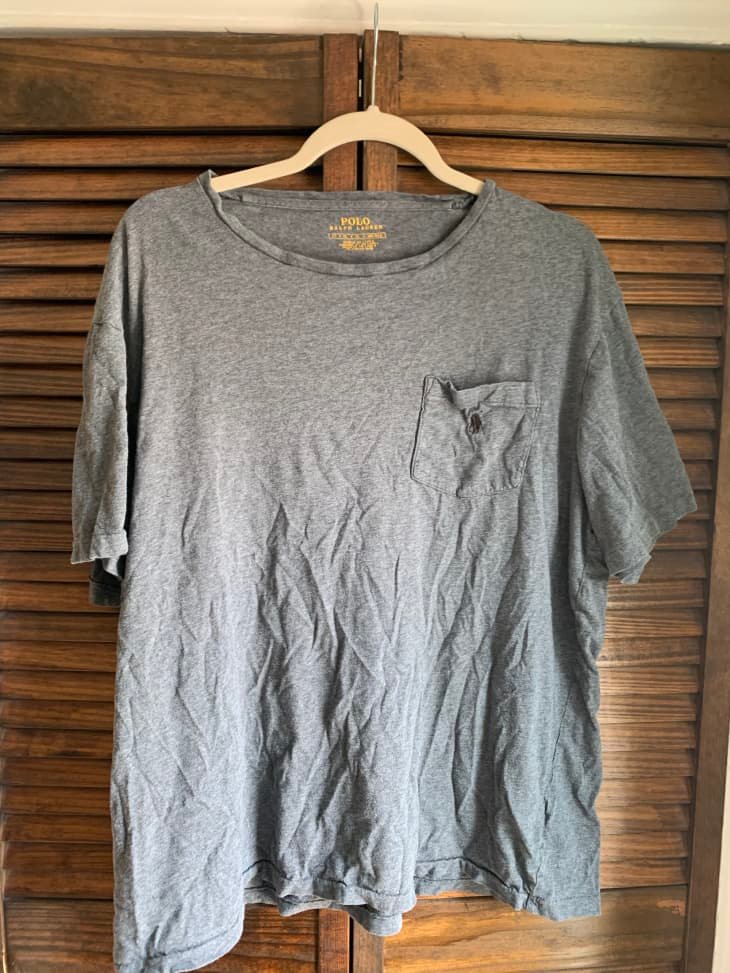
The fastest GSM t-shirt test there is. Single layer, arm’s length, look through it. Sheer means thin. Takes two seconds. If you can make out the shape of your hand clearly, you’re under 160.
2. Bunch it in your fist and let go
Heavier fabric falls open on its own. Thin fabric stays crumpled and clingy, because there’s no weight to pull it back down.
3. Look at the shoulder seam on the hanger
A thin oversized tee collapses inward at the shoulder — there’s nothing there to hold the line. A heavy one keeps its shape even hanging.
4. Check the hem
Cheap tees curl at the bottom hem within a few washes. It’s a knit tension issue, but it correlates almost perfectly with corner-cutting everywhere else.
5. See whether the brand tells you at all
If a brand prints the number, 200+ and they’re saying it because they’re proud of it. Silence usually means 160. Nobody hides a good spec.
Why more GSM isn’t automatically better
This is the part where a lot of brands overplay their hand, and I’d rather not.
A 280 GSM t-shirt in Hubballi in May is a punishment. It’s a lovely fabric and you will hate it by 11 am. Weight buys you structure and opacity, and it costs you breathability. That’s a real trade, not a marketing detail.
Anyone telling you heavier is always better is selling you heavier.
What the GSM number doesn’t tell you
Two tees at an identical GSM t-shirt rating can feel completely different. Here’s what else is in play:
- Combed vs carded cotton. Combing strips out the short fibres. It’s why one shirt feels smooth and another feels slightly hairy at the same weight.
- The knit. Single jersey, interlock, and pique all behave differently on the body even at matching GSM.
- Bio-wash and finishing. This is where softness actually comes from. A bio-washed 200 can feel nicer than an untreated 240.
- Garment treatment. An acid wash changes hand-feel and drape noticeably, and the spec sheet won’t warn you.
- Blends. Sneak in 20% polyester and you hit the same GSM cheaper, with worse breathability and a faint sheen.
So GSM is the first question. It’s just not the only one.
What we print on
Everything we make is 240 GSM cotton. It’s on every product page, because it’s the first thing we’d want to know as buyers.
The reasoning for landing on 240: heavy enough that a drop shoulder actually drops instead of hanging off you like a bedsheet, light enough to wear through a Karnataka summer without regret. Anything heavier and we’d be selling you an expensive way to sweat.


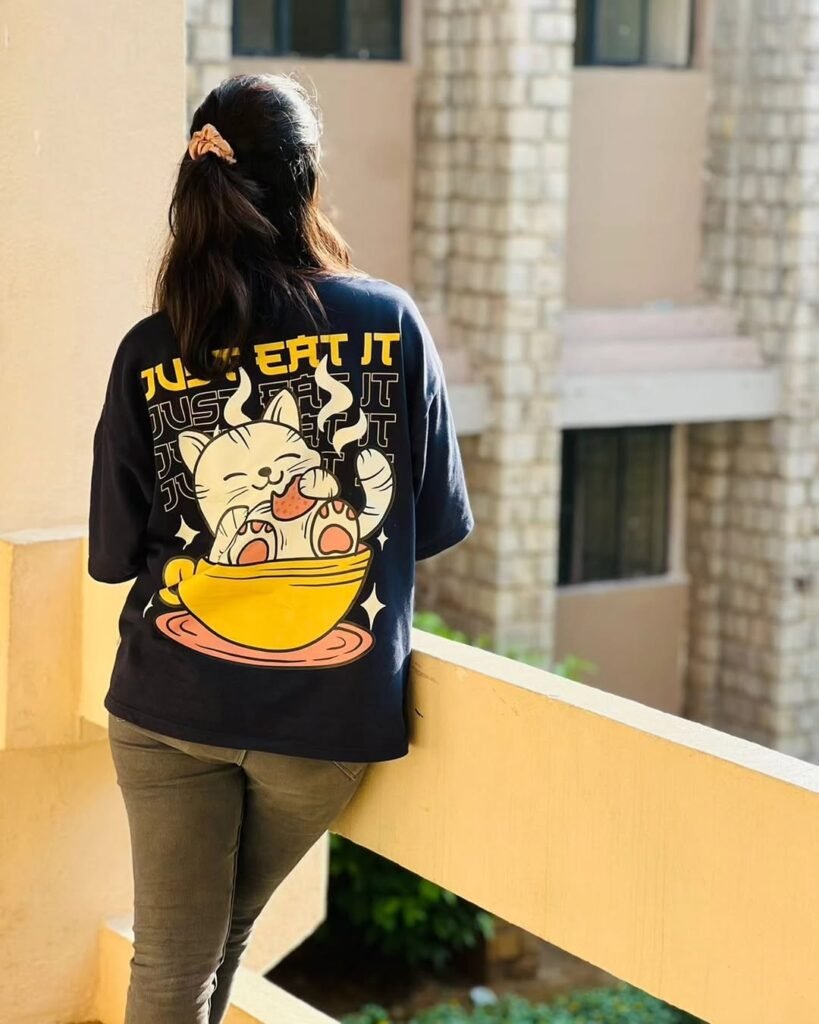
Model : Prithvi Naik
If you want to see what that weight looks like on a body, the spiritual streetwear range is where most of our heavier prints live, and the anime tees run on the same base fabric. Same cotton, different gods.
Frequently asked questions
What is the best GSM for a t-shirt in India?
180–200 GSM for regular fit and daily wear. 220–240 GSM for oversized and drop-shoulder cuts, which need the weight to hold shape. Above 260 gets uncomfortable in most Indian summers.
Is a 240 GSM t-shirt too heavy for summer?
No, if it’s pure cotton. A 240 GSM t-shirt in pure cotton breathes better than a 180 GSM polyester blend. The fibre matters as much as the weight.
Is 180 GSM good quality?
For a regular-fit tee, yes, perfectly reasonable. For an oversized tee, no — it’ll cling and lose shape, because the cut depends on the fabric having enough weight to fall.
Does GSM t-shirt weight affect print quality?
Yes. Heavier fabric gives the print a more stable surface, so it cracks less over time. Thin, stretchy fabric flexes with every wash, and the print flexes with it until it doesn’t.
Does GSM change after washing?
Slightly. Cotton shrinks a little on the first wash, which nudges GSM up while the garment gets smaller. Pre-shrunk fabric minimises this. Not worth thinking about.
The short version
Check the GSM t-shirt spec before you buy. If it is not there, hold the shirt up to a light and trust your eyes.
You’re not paying for a printed graphic. You can get that anywhere for ₹299. You’re paying for the fabric that graphic is going to live on for the next three years.
Our most-loved tees are a decent place to start, or browse everything if you’d rather dig.